



A throw-in can look routine until a foot lifts, an opponent crowds the taker or the referee changes the team taking it. This guide follows the IFAB 2026/27 Laws, checked on 7 October 2026, and separates the throwing action from what happens afterwards.
Start with the boundary
The whole ball must cross the touchline, whether rolling or airborne, to be out. The painted line belongs to the area it encloses. A ball hanging over the line can therefore still be in play: judge the entire ball, rather than only its contact with the grass. Read the rule: IFAB Law 9, IFAB Law 1.
Use a legal throwing action
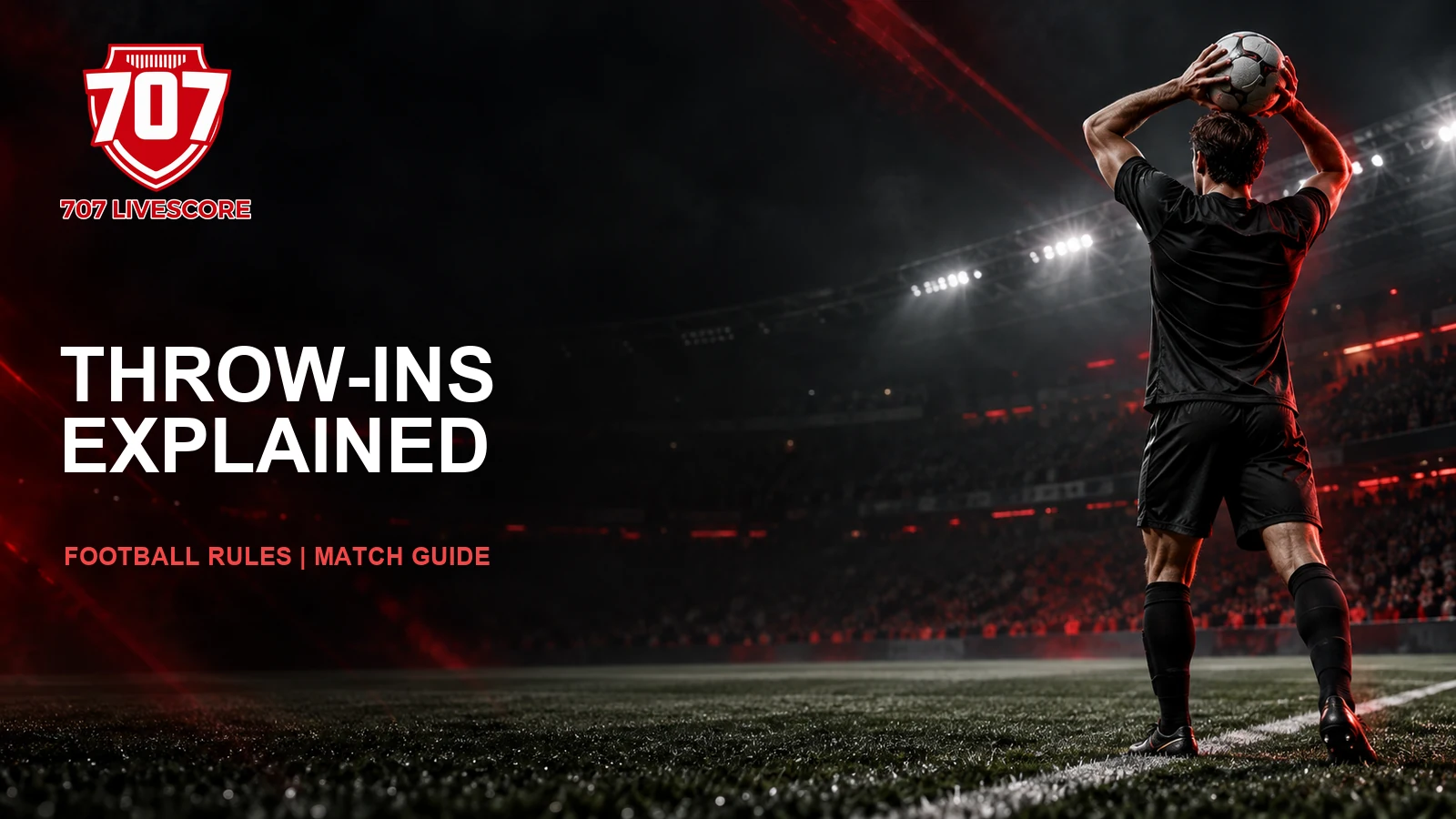
The opponents of the last player to touch the ball normally receive the throw. Face the field and release with part of each foot on the line or ground outside it. Use both hands, taking the ball from behind and over the head, at the point where it went out. Opponents must stay two metres from that point.
A bounce before the ball enters means the same team retakes. An incorrectly taken throw normally passes to the opponents. After entry, the thrower must wait for another player’s touch before touching it again; an ordinary second touch brings an indirect free kick. Handball brings a direct free kick, or a penalty inside the thrower’s penalty area; a goalkeeper handling there concedes an indirect free kick. An untouched throw entering the opponents’ goal produces a goal kick; into the thrower’s own goal, a corner. Read the rule: IFAB Law 15.
Recognise the five-second countdown
Under the current countdown protocol, deliberate delay lets the referee whistle, signal and count down five seconds with a raised hand. This is a referee-triggered response, rather than an automatic clock on every throw. The referee need not wait until a player holds the ball.
If time expires, the opponents take the throw from the same place. However, the protocol protects a player already in the act of throwing as the count ends. A caution for this delay follows only if the player or a team-mate then excessively delays the opponents’ restart. Read the rule: IFAB throw-in and goal-kick countdown protocol.
Understand why the referee may allow play
The referee can apply advantage after an incorrectly taken restart when the ball is in play and the opponents benefit. An awkward throw that an opponent collects may therefore lead to continued play. If the expected advantage does not develop immediately or within a few seconds, the referee can return to the restart decision. Read the rule: IFAB Law 5.
Watch the goalkeeper and nearby opponents
A goalkeeper ordinarily cannot use the hands or arms inside their penalty area on a throw received directly from a team-mate. That produces an indirect free kick. Law 12 includes an exception after the goalkeeper clearly kicks or attempts to kick the ball to release it into play.
Failing to respect the required distance is a cautionable offence. Distance is therefore part of proper defending at the restart, not merely a courtesy to the thrower. Read the rule: IFAB Law 12.
A practical way to practise
For training, separate accuracy from distance. Mark a release point, choose a nearby target and have a partner watch the feet and arm movement. Increase range only when the action feels repeatable. When watching a match, follow the sequence: boundary, release, next touch and referee signal. That makes a confusing decision easier to reconstruct without guessing from the final outcome.
Sources
- IFAB Law 15
- IFAB Law 1
- IFAB Law 9
- IFAB throw-in and goal-kick countdown protocol
- IFAB Law 5
- IFAB Law 12
The same delay protocol also covers goal kicks, where an expired countdown awards a corner. For why a referee may let an opponent’s attack continue after a faulty restart, read football advantage explained.